
Governance is not a modern invention; it has existed in various forms for centuries. Long before the emergence of corporate structures and regulatory frameworks, systems of governance were embedded in the administration of kingdoms and empires. During the era of monarchies, kings ruled through established courts comprising courtiers, advisors, and ministers. These ministers, in turn, relied on networks of regional officers, envoys, spies, and agents who gathered timely information from across the state.
There was typically a clear hierarchy for issuing directives and receiving feedback. Orders flowed downward from the ruler through successive layers of authority, while information regarding public welfare, security, taxation, and administration flowed upward to support informed decision-making. This structured flow of authority and information ensured control, coordination, and accountability within the realm.
In the present day, governments operate under far more formalized and institutionalized governance frameworks. Modern governance structures are defined by constitutional mandates, legislative bodies, executive authorities,
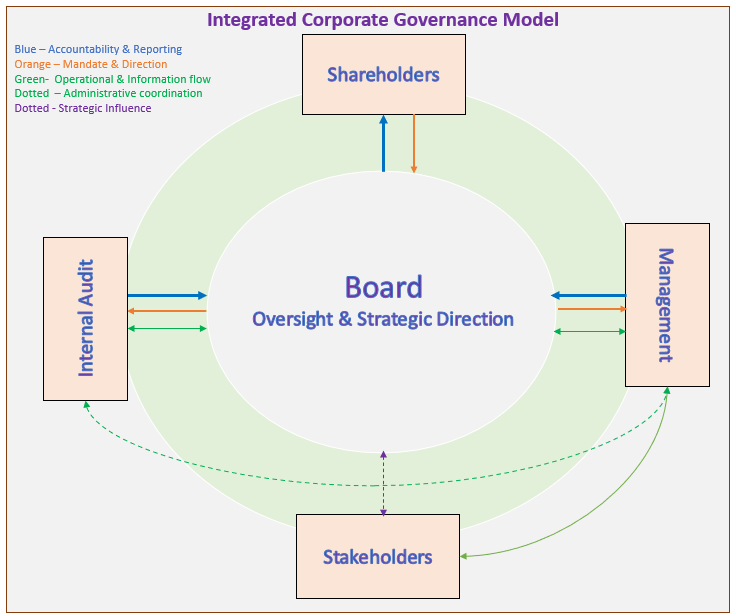
regulatory agencies, and judicial oversight. Technology now enhances transparency, communication, monitoring, and data-driven decision-making. Despite these advancements, the fundamental principles remain unchanged: clear structures of authority, defined processes, accountability mechanisms, and continuous information flow to enable effective oversight and strategic direction.
The foundations of industrial governance can be traced to early joint-stock companies such as the British East India Company (established in 1600) and the Dutch East India Company (established in 1602). These entities introduced the separation of ownership and management, as investors (shareholders) provided capital while appointed directors and managers conducted operations. This separation created the earliest governance challenges—how to ensure that managers acted in the interests of owners.
The Industrial Revolution (approximately 1760–1840) accelerated the need for formal governance structures. Rapid industrial expansion in Britain, Europe, and the United States led to the creation of large manufacturing enterprises requiring significant capital investment. The introduction of limited liability laws in the mid-19th century, particularly the UK Limited Liability Act of 1855, encouraged broader share ownership and strengthened the board-based governance model.
A major intellectual milestone came in 1932, when Adolf Berle and Gardiner Means published The Modern Corporation and Private Property. They formally articulated the problem of the separation of ownership and control in large corporations, highlighting the risk that managers might prioritize their own interests over those of shareholders. This work laid the theoretical foundation for modern corporate governance.
The stock market crash of 1929 and the subsequent Great Depression led to stronger regulatory oversight. In the United States, the Securities Act of 1933 and the Securities Exchange Act of 1934 established disclosure requirements and created the U.S. Securities and Exchange Commission (SEC), marking a turning point in regulatory governance.
The late 20th century saw renewed attention to governance following major corporate failures. The collapse of Enron in 2001 and WorldCom exposed serious weaknesses in board oversight, internal controls, and audit independence. In response, the U.S. enacted the Sarbanes–Oxley Act in 2002, strengthening internal control requirements and auditor independence. Similarly, the UK issued the Cadbury Report in 1992, which significantly influenced global governance codes.
In recent decades, governance in the industrial sector has expanded beyond shareholder protection to include stakeholder interests, environmental responsibility, and sustainability. Frameworks such as the OECD Principles of Corporate Governance (first issued in 1999 and revised thereafter) reflect this broader perspective. Today, industrial governance integrates board oversight, risk management, internal control, regulatory compliance, and stakeholder accountability-built upon centuries of evolving practice and reform.
